Showing posts with label race. Show all posts

21 October 2007

Maybe God Hates Your Racist Mascot

I'm writing this in the bottom of the eighth

So, when the Indians' not quite unprecedented collapse is postmortem-ed on sports talk radio, ESPN, and in the newspapers, two moments from game 7 will stand out. The first is Indians' 3rd base coach Joel Skinner's decision to hold Kenny Lofton on a fluky Franklin Gutierrez single when he could have scored from second without a throw in the top 7th. On the next play Casey Blake grounded into a double play, stranding Lofton on third and leaving the Red Sox up 3-2. The second is manager Eric Wedge's bad mojo decision to pull starter Jake Westbrook after six innings, despite the fact he had retired eight Red Sox in a row and was cruising. Reliever Rafael Betancourt promptly gave up a two-run homer to mighty mite Dustin Pedroia: 5-2 Red Sox. After Jonathan Papelbon retired three in a row with two inherited men on in the top eighth, the Sox came back to put the Tribe out of their misery in the bottom frame, with Pedroia hitting a bases-clearing 3 RBI double, and Kevin Youkilis tatooing a 2 run homer. Now we sit in the top of the 9th, 1 out, 11-2 Red Sox.

17 October 2007

Um, Yeah, So About This Being America in 2007


This happened yesterday

So after watching the Cleveland Indians and their fans for two consecutive rounds of the MLB playoffs, I have come to the conclusion, that, yeah, the whole thing is kind of racist. Well, I shouldn't say that I "came to the conclusion": I've thought that for a while, it's just that the Indians (and their fans) have been out of sight, out of mind for a long time prior to this year, and while I was fretting over the Mets' season-ending self-immolation jag, I really didn't have a lot of time to think about what a horrendously racist caricature the Chief Wahoo logo is, or how mind-blowingly inappropriate it is for middle-aged white guys to paint their faces red, put on headdresses, and engage in mocking facsimiles of stereotyped Native American rituals culled from equally racist 1950's western serials.

Lately, in college athletics, there has been a renewed push to eradicate mascots offensive to Native Americans; the NCAA has even threatened to ban schools with such nicknames and logos from postseason competition. In some instances, such as the University of Illinois' decision to drop Chief Illinewek, a clear-cut good has been accomplished. In other cases, such as Florida State University's successful bid to retain its 'Seminoles' nickname, the issue is a bit more complicated: the Seminole Tribe of Florida has officially endorsed the University's use of the nickname; however student rituals such as the "tomahawk chop" and stereotypical chanting (also employed by fans of the Atlanta Braves baseball team) are definitely of questionable taste. The overall trend, however - one that has been duplicated at the secondary and primary school levels throughout America - is that more and more Native American mascots have been consigned to the dustbin of history, so that our ancestors can look at them in textbooks generations hence and wonder what the fuck we were thinking.

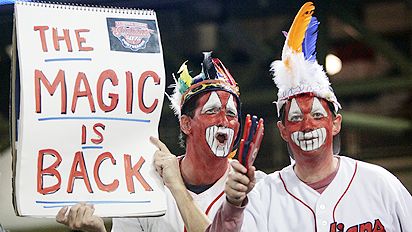
In professional sports, there has been no comparable campaign to eliminate offensive Native American team names - the Cleveland Indians, Atlanta Braves, Chicago Blackhawks, and Washington Redskins all remain in circulation. In fairness, there have been minimal attempts to mop up the image around the edges a little bit - the Braves eliminated Chief Nokahoma (say it out loud) and the Indians have adopted this bizarro furry purple thing named Slider as their mascot, instead of, say, the guys in the photo at the top of this post. Indians' owner Larry Dolan has even made noises about dropping Wahoo occasionally, and the Indians have pointedly introduced an alternate cap replacing the offending image with a letter 'I' (though it has been entirely absent throughout these playoffs). However, all four of these franchises have long, storied histories, and as such have fanbases steeped in their traditions for generations - traditions with which the offensive nicknames and logos are inextricably bound up. Such brand loyalty is enormously difficult to overcome (imagine if someone floated the idea of changing the Yankees to the Devil Rays or something equally stupid), and doubtlessly a primary factor in ownership's continued unwillingness to make a change.

In a bizarre way, I kind of feel bad for Cleveland's fans - a) they probably grew up rooting for the team because their father did, and his father did, so on and so forth, b) they didn't pick the name or the logo, and c) I imagine that a lot of them are pretty embarrassed to have to sit next to the guys in the picture at the top of the post. I can afford to feel superior because I root for the Mets (wait, did I just say I could feel superior to fans of a team up three games to one in the ALCS because I root for the Mets?), and so far no people with giant baseballs for heads have come out of the woodwork screaming bloody murder; if I was born in Cleveland, who knows what I would think?

Yet, even tradition can serve as only so much of a fig leaf, and a pretty flimsy one at that. I'm not going to take you on a walk down memory lane, but we've also got quite the long and storied tradition in this country of pulling fucked-up racist shit, from slavery, to Native American genocide, to the Chinese Exclusion Act, to segregation and Jim Crow laws, so on and so forth; Chief Wahoo remains a direct and obvious link to that lineage of shame. I'm sorry that changing it would mean that Cleveland fans would have to go and buy new caps and jerseys (Larry Dolan I hear $$$); however I'm not sorry that it would put an end to Fox cameras panning to a couple of jerkoffs in redface mid-inning while Joe "I can't believe Randy Moss just faked-mooned some drunk Packers fans - THAT'S DISGUSTING!" Buck continues blathering on with Tim McCarver like "ain't nothin' wrong with that!"

16 October 2007

(Don't) Gimme Indie Rock?


An ideal for listening?

Some more thoughts on SFJ's "A Paler Shade of White":

I think the tenor of Frere-Jones' piece is polemical; that is to say, I don't think that he's necessarily making a blanket claim that all white rockers are collectively moving away from black sounds. Such a claim could be refuted easily enough: even within the confines of indie rock itself, acts like The White Stripes, !!!, and The Rapture are directly drawing from black influences with their blues, funk, and dance derived approaches respectively - SFJ certainly knows this. Frere-Jones is actually trying to kick start (or restart, depending on the audience) a much more nuanced debate, which brings me to:

Why pick on indie rock? There is an unsubtle disconnect between discussing Wilco and the Arcade Fire, and, say, The Clash and the Rolling Stones. The latter groups have sold tens if not hundreds of millions of records combined and are literally world-renowned; if Wilco and the Arcade Fire have sold a combined 1 million copies of their most recent albums I would be shocked. In fact, if Neon Bible and Sky Blue Sky have sold as many copies in a combined 12 months of release as Kanye West's Graduation moved in its first week, I will eat my hat. Again, Frere-Jones is probably not living in an internet bubble (you know, the one that made you think that Annie and M.I.A. are household names). Black music - that is musics that are directly conversant with ongoing trends in mainstream African-American music - has basically won the day from a commercial perspective. Timbaland, Justin Timberlake, 50 Cent, Jay-Z, Rihanna, Kanye West, and Maroon 5 - even in a fragmented mainstream, these are the predominant sounds of young America today.

So, again, why pick on indie rock? Well, I think the answer lies in SFJ's rather unsubtle linking of his piece with a rather famous (or infamous, depending on your perspective) article by rock critic Lester Bangs. "The White Noise Supremacists", first published in the Village Voice in 1979, is an unflattering portrait of the New Wave scene in New York: a scene marked out in Bangs' mind not only for its reactionary "white" aesthetic - a reaction to that dominant "black" music of the day, disco - but its employment of punk's embrace of anti-social stances as a vehicle for overtly racist attitudes. The piece is peppered with benighted anecdote after benighted anecdote - you really ought to read them yourself, but I'll share one of the relatively tamer examples here - one I feel is most illustrative of the point Frere-Jones is driving at:
Something harder to pass off entered the air in 1977, when I started encountering little zaps like this: I opened a copy of a Florida punk fanzine called New Order and read an article by Miriam Linna of the Cramps, Nervus Rex, and now Zantees: "I love the Ramones [because] this is the celebration of everything American - everything teenaged and wonderful and white and urban..." You could say the "white" jumping out of that sentence was just like Ornette Coleman declaring This Is Our Music, except that the same issue featured a full-page shot of Miriam and one of here little friends posing proudly with their leathers and shade and a pistol in front of the headquarters of the United White People's Party, under a sign bearing three flags: "GOD" (cross), "COUNTRY" (stars and stripes), "RACE" (swastika).
"...everything teenaged and wonderful and white and urban..." Now, bear with me for a moment here, but if you make the "white" implicit in that sentence (and maybe change the "teenaged" to "twentysomething"), how is this not an acceptable description of the rapidly gentrifying quarters of Brooklyn, Chicago, Philadelphia, Washington, Los Angeles - those increasingly bleached out post-graduate boho enclaves where indie rock in America basically makes its bed? I'm not saying that the indie rock scene is racist, or that Frere-Jones is trying to say that, but I do think that where he and Bangs intersect is over the concept of "our music."

The stimulus and the response in each case is vastly different. Bangs' punks are deliberately trying to develop an aesthetic rooted specifically in their community; a community defined at least in part in opposition to the dominant New York sounds of the day - the black musics that would go on to become disco and, later, hip-hop. Punk and New Wave are "their" music because it originated with them; part of their paradigm is ethnic. (Obviously Bangs' point is a generalization, but is not too extreme - a lot of the names in that article are big players from that scene, not just indicative of some wingnut fringe.) Frere-Jones' indie rockers, on the other hand, are certainly reacting to the mainstream, but their problem is more about form than a question of taste.

The rise of the "doctrine of racial sensitivity" coupled with rap's ascendancy as the dominant idiom in black music has presented white rock musicians with something of an insuperable challenge. Suddenly, the "miscegenation" (Frere-Jones' term) that had been rock and roll's defining characteristic was subject to intense scrutiny: "Dabbling in black song forms, new or old, could now be seen as an act of appropriation, minstrelsy, or co-optation." This new political correctness meant that cultural boundaries that were once freely disregarded (rightly or wrongly), became warily observed. Simultaneously, rap, now the cutting edge in black music, presented its own unique set of problems to white performers: content-wise, it is strongly grounded in the urban African-American experience (an experience obviously alien to most white Americans), and technically, it's difficult if not impossible for white people to credibly reproduce modern hip-hop's specific cadences without "sounding black" as it were - at best, you'd sound faintly ridiculous; at worst you would be charged with wholesale cultural expropriation. Frere-Jones posits that the response to these twin pressures by the indie rock community was what legal scholars have come to refer to as "avoision": a "gray area of ambiguous acts" that fall between avoidance and evasion.

The result of this "avoision", according to Frere-Jones, is that indie rock has backed itself into a corner, cut off from the black musics that represent the main artery of American musical innovation. The indie rock community - a community, if you will, composed mostly of young white educated liberals - is both aware of the peculiar burdens of history (that Elvis "stole" rock and roll now constitutes received wisdom), and at the same time not particularly receptive to hip-hop as a form. Has all indie rock formed within this very narrow psychic space? Of course not. But what Frere-Jones is suggesting is that as the genre has begun to enter the mainstream consciousness, the exemplars of this success - The Arcade Fire, Modest Mouse, The Decemberists, The Shins, etc. - are basically making music that is pale going on translucent. Rather than engaging with other musics, as The Clash did most prominently with Sandinista! (SFJ's example), these bands seem to be drawing from so-called "safe" influences, like Brian Wilson and Bruce Springsteen. Whether by accident or design, indie rock has entered what Frere-Jones sees as a creative cul-de-sac that is rendering the music increasingly stagnant.

So is he right? Well, he's under attack from two sides (at least): those who think that indie rock is perfectly fine the way it is, and those who believe that, though the musical polyglot SFJ believes existed during his youth may no longer be around, the fact is that we've got such an enormous amount of new and exciting music to choose from, that what does it matter? (The flip side to this argument is something Frere-Jones tacitly acknowledges - we still have black music, it's just that black people are its public face and they reaping more of the profits - a point with considerable merit.)

I'm not exactly certain how to address the first point, except to say that I've been getting pretty tired of indie myself lately, and for much the same reasons as Frere-Jones: there's only so much atonal singing, chamber music instrumentals, lyrical obtuseness, and conceptual nonsense that a man can take. That's not to say that there hasn't been some great indie rock this year - Of Montreal's Hissing Fauna, Are You the Destroyer?, for instance, is a particularly exciting and inventive record. On the whole though, the incestuousness bleeds through more and more with each new listen, and I find myself devoting far more time to seeking out and listening to older records than I used to.

The second point is more interesting, because it does make sense, at least on the surface: as the mainstream has become increasingly fractured and the internet has vastly increased the avenues by which we can learn about and consume new music, why should this be considered a problem? In a sense, to each his own; the mutual exclusion of black music and indie rock has not hurt the diversity of musical choices out there. This line of reasoning has its appeal. In a sense, it refutes Frere-Jones' claim as somewhat reductive and solipsistic, boiling his argument down to "Things were better in the good old days" and "I don't like Yankee Hotel Foxtrot." Those attacking Frere-Jones along this line don't necessarily view his piece as a wholesale assault on indie rock (which many of them have even less use for than he does), but a self-aggrandizing attempt to diagnose a non-existent problem.

So, does a problem exist? That is a very loaded question, and I imagine damn near impossible to answer to anyone's total satisfaction. The heart of Frere-Jones' argument is that a continued interplay between black and white is at the very core of what rock and roll is, and that if the conversation (or whatever you would label it as) stops, this crucial cultural locus ceases to be. The real controversy, I suppose is over where the stealing stops and the exchange begins, or whose chocolate got into whose peanut butter, or whether there actually is enough of definitive sample of prominent indie rock groups that fit SFJ's particular notion of enforced whiteness to make his case stand up. And who's to say that The Arcade Fire don't have "black" elements in their music? Anyone who thinks they totally eschew "ecstatic singing" or "palpable bass frequencies" hasn't heard "Rebellion (Lies)"; anyone who thinks they don't demonstrate "elaborate showmanship" has never seen them live.

Ultimately, Frere-Jones' argument rests on whether or not you believe that there is a deeper emotional truth at work: that indie acts truly are "settling for the lassitude and monotony" they "seem to confuse with authenticity and significance." Perhaps this claim is a rhetorical bridge too far. Yet ultimately, it is not the job of the polemicist to resolve but to provoke, and it is clear that Frere-Jones has managed that much successfully. Let a hundred flowers bloom, etc.

Race Music


Not a coincidence

Every other issue of The New Yorker these days seems to be a "The _______ Issue." "The Food Issue", "The Summer Fiction Issue", "The Style Issue", "The Winter Fiction Issue", etc. Having had a subscription to the magazine for some years now, and having just recently gone through some roughly 200 back issues that have been occupying valuable real estate around here, I believe I can authoritatively state that "The ______ Issue" overload is a relatively recent phenomenon; perhaps the editorial staff is taking more vacation nowadays (special issues usually count as two regular issues, thus shortening your subscription and allowing an extra week or two before the next edition).

Anyway, this week "The Arts Issue" arrived at my door, and in it, a most interesting piece by resident pop scribe Sasha Frere-Jones on the so-called whitening of rock. "A Paler Shade of White" is the sound of a gauntlet being thrown. Frere-Jones thesis is simple, and on its surface, self-evident: rock and roll, once "the most miscegenated popular popular music ever to have existed", has been progressively drained of its "blackness" - the result of a pop music schism that began with the ascendancy of hip-hop as a co-equal genre and the concurrent infusion of political correctness into pop culture during the late 1980s and early '90s. The chief culprit is indie rock, which by the mid-nineties, according to Frere-Jones, "implicitly came to mean white rock." (Metal and, uh, Nickelback apparently are unindicted co-conspirators.) Not so implicitly, he laments this development, articulating the glaring truth that something has been lost during the course of this de facto re-segregation.

Frere-Jones got me thinking of another piece, this one by Robert Christgau, on the subject of post-modern minstrel studies, that appeared in the February 2004 issue of The Believer. "In Search of Jim Crow" is a fascinating rumination on the nature of minstrelsy, and, since I cannot hope to do justice to Christgau's argument on such a sensitive subject by synopsizing it, I will let him speak for himself.

What both articles have in common is the authors' belief that the story of American music (rock and roll and minstrelsy being distinctively American idioms) is not solely about cultural appropriation - that is, theft - but an ongoing conversation wherein, as Christgau puts it, "Conduits have a way of connecting to other conduits." When we seek to create our own hermetic cultural spaces, whether as a product of self-consciousness or aversion, we are struggling in a sense against a larger American narrative. Whether or not this has rendered Wilco, The Arcade Fire, or Pavement the poorer is unclear, but when Frere-Jones trots out antecedents like The Rolling Stones, The Clash, and Led Zeppelin to make his case, it's tough not to feel like something's missing, or that we're missing something.

Addendum: And now the accompanying podcast and blog post - you know, there used to be a time when it wasn't S.O.P. to try and preempt your critics, especially when you've explicitly acknowledged that you're deliberately provoking them.

15 October 2007

Gray Skies Are Gonna Clear Up!

Cheery!

Our latest installment of the Leonard Lopate show features our hero (...Leonard Lopate) interrogating that feckless chronicler of maritime history, Marcus Rediker, whose latest rollicking romp, The Slave Ship: A Human History, catalogues the trans-Atlantic trade in people and how it contributed to the development of modern capitalism, among other things. Let's listen in, shall we?


25 September 2007

Rip Van Kemp

"Sir, 'The Shocker' is with your pinky, not your ring finger."

Former Congressman, Bob Dole VP candidate, Buffalo Bills QB, and supply-sider Jack Kemp (R-NY) made either an astute or completely oblivious observation in last Wednesday's Washington Post. The article, "Debate No-Shows Worry GOP Leaders", addressed the refusal of leading Republican presidential candidates to attend debates targeted at primarily African-American and Latino voters. Rudolph Giuliani, Fred Thompson, Mitt "Way!" Romney, and John McCain have all begged off a debate hosted by talk show host Tavis Smiley to be held at Baltimore's Morgan State University and aired on PBS; all save for John McCain also skipped a similar forum broadcast on the Spanish-language network Univision. Concerned that the GOP could be sabotaging its future electoral prospects by essentially bricking itself off from the growing electoral influence of minority groups, Congressman Kemp said:
We sound like we don't want immigration; we sound like we don't want black people to vote for us. What are we going to do -- meet in a country club in the suburbs one day? If we're going to be competitive with people of color, we've got to ask them for their vote.
The cheap laugh here is obviously the idea that Republicans don't already meet in a country club in the suburbs. Arguably, a not insignificant reason for the Democrats' 2006 victories was that voters in swing districts and states perceived their representatives to be out of touch, pigging out on the tabs of K Street lobbyists instead of addressing their constituents' needs and concerns. The GOP, which had swept into Washington in 1994 with a mandate to purge the excesses of Democrat's nearly 40 year reign, left town twelve years later as the lap dog of America's wealthy corporate elite.

Kemp's criticism is particularly resonant because he is not the first Republican to evoke the Arcadian imagery of the country club to characterize the party's aloofness. In fact, "Country Club Republican" is the gentlemanly pejorative for practitioners of the socially moderate-cum-liberal, business-friendly but economically "responsible", non-ideological Republicanism practiced by the Dwight Eisenhowers, Nelson Rockefellers, and Tom Keans of the world. The movement conservatives who currently control the GOP came to power deriding these Mayflower-descended elites, sensing that they were not sufficiently dedicated to a socially conservative, anti-tax message - the message the party has used to successfully woo millions of working class whites into the GOP fold. The Country Club set has managed to retain control of the Republican Party across the Northeast, where the mainstream GOP message holds the least appeal, but their grip even here is tenuous; they are being squeezed into irrelevance by the increasing regional dominance of the Democratic Party, a development rank-and-file Republicans are attributing more and more to insufficient ideological purity amongst their leadership.

Kemp's argument is merely a logical extension of this viewpoint. Taking the place of patrician stuffed shirts is the burgeoning "if you're white, you're right" mentality of Republican leaders, reacting both to the hard line anti-illegal immigration positions of the rank-and-file, as well as an implicit anti-urbanism that is now virtually a plank in the party platform. Republican presidential candidates, concerned with appealing to primary voters, are under tremendous pressure to demonstrate their bona fides on the immigration issue. This manifests itself not only in a game of "see-if-you-can-top-this" vis-a-vis who's immigration plan is more draconian, but as a rhetorical firefight where no one (again, save John McCain, and even he's trying to change the subject) wants to be seen ceding a sliver of ground. Skipping the Univision debate was a short term tactical maneuver designed to avoid the appearance of pandering to an audience unschooled in the Mother tongue - a voting block unlikely to provide much support in, say, the Iowa caucuses.

Essentially Republicans find themselves straddling the fault line between the discontent of their traditional white base and the fact that Latinos represent the fastest growing segment of the American electorate. While GOP candidates are quick to differentiate between legal and illegal immigration, and swifter still to decry overt xenophobia or racism, the fact of the matter is that the ugly tenor of the debate is still audible through the static. Many Latinos who are either American citizens or reside here legally fear that the tremendous gains their community has made, economically and in terms of larger social acceptance, could be eradicated by a heavy handed enforcement-oriented approach towards illegal aliens. By identifying itself too strongly with anti-illegal immigration policies, the GOP could unintentionally signal to Latinos that it is either uninterested in their votes or actively working against their best interests - a perception mirroring the attitude of African-Americans towards the party. Unlike African-Americans, however, the GOP cannot concede the Latino vote to the Democrats without dealing a severe blow to the party's ability to compete, especially in swing states where Latino voters sometimes form a significant proportion of the electorate.

Kemp's concerns, however, are not merely a reaction to the arithmetic of political expediency. If the Republican party is to survive as a viable political organization deep into the 21st century, it is going to have to not only win a greater share of the minority vote, it is going to have to convert more minorities to Republicanism. President Bush, who carried 40% of the Latino vote in 2004, was attuned to this distinction, effectively highlighting the links between his governing philosophy and the traditional cultural conservatism and strong work ethic characterizing many Latino American households. He has also prioritized the placement of African-Americans and Latinos in positions of prominence in his administration: Colin Powell and Condoleeza Rice as his Secretaries of State, ex-Attorney General Alberto Gonzales, and former Secretary of Education Rod Paige. One can characterize these appointments as mere tokenism, not indicative of the overall Bush track record, but it should be acknowledged that tokenism is certainly not confined solely to the Republican party, and that even token appointments can send a strong signal about a person or party's political values.

Fascinatingly, Bush's most ambitious attempt to enhance Republican prestige with Latinos was his plan to dispose with the illegal immigration issue once and for all - the very same plan that all of the Republicans hoping to succeed him (again, save John McCain) are defining themselves in opposition to. The President proposed an amnesty program that would offer the estimated 12 million illegal aliens residing in the United States a path to citizenship and would establish a temporary guest worker program, permitting migrant laborers to enter and exit the U.S. legally. It's a powerful idea; by enacting such an amnesty, Bush could essentially have his own Lyndon Johnson moment, enfranchising a significant new bloc of voters while demonstrating to Latino community that the Republican Party is capable of advancing its interests. It's not precisely analogous to 1964; after all, the Democrats are unlikely to try and exploit an amnesty's polarizing effects, as the Republican Party did with the Civil Rights movement in developing the so-called "Southern Strategy." However, it would play a big role in maintaining the GOP's viability with Latino voters, preventing the Democrats from gaining an immutable political advantage. An amnesty would be a practical demonstration of the Republicans' vaunted commitment to hard work and economic opportunity; what could be better than allowing more people a shot at owning a piece of the American dream?

Bush's amnesty is, of course, dead at the hands of his fellow Republicans. Certainly I don't wish to characterize the President's plan as flawless or perhaps even the best course of action, but the policy's fate was not arrived at based upon its merits anyway. The GOP's base revolted against the very concept of an amnesty, and Republican leaders, already reeling from Iraq and scandal after scandal, decided that backing any version of the President's plan was too costly. The primary circus, with its demands for demonstrations of fidelity to the mainstream Republican program, is only serving to exacerbate the situation.

Queried about the front-runners' apparent unwillingness to address Latino and African-American audiences, one unnamed adviser to a GOP presidential candidate retorted, as only an anonymous hack can, "What's the win?" The moral response: having a presidential candidate demonstrate that he won't totally ignore roughly a quarter of the American people, a figure sure to have grown since the 2000 Census. The cynical response: you won't join the Whigs in the history books by 2050.

15 July 2007

The Fire Next Time

Yeah I know all about that

Released in 1995, director Mathieu Kassovitz's La haine (Hate) is a portrait of life in the banlieues, the ghettos heavily populated by North African immigrants that ring France's major cities. The film, shot in razor sharp black and white, strongly parallels the work of Spike Lee (Do the Right Thing) and Tony Kaye (American History X), both in substance and in style.

The film's principal concern is with the conflict between its disenfranchised protagonists - Vinz, a Jew, Said, an Arab, and Hubert, an African - and the police. An acquaintance of the three - it's never clear how close they actually are - has been savagely beaten by police and is hospitalized in critical condition, sparking off a destructive series of nightly riots. The banlieue itself is a moonscape, filled with remnants of Brutalist architecture, burning automobiles, and storefront windows bereft of glass.

Mr. Kassovitz's personal sympathies are clear - the police, either bedecked in militaristic riot gear or sinister plainclothes (complete with armbands) operate like a gang unto themselves, seemingly concerned only with enforcing and maintaining their empty authority. They are the manifestation of an uncaring state, perplexed by the problems presented by the ghetto-ized, underemployed "un-French" Other, and seemingly unconcerned with persuing any other solution than tramping the dirt farther down. Where Mr. Kassovitz differs from most cinematic polemicists however is in his unromanticized treatment of his banlieue denizens. His characters are anti-social petty criminals, unyieldingly recalcitrant in their dealings with authority even when authority acts with good reason and in a reasonable fashion. Kassovitz understands the potentcy of the truth, and equipped with this knowledge he has no need for martyrs. The system is failing these youths and this failure manifests itself not only in their environment but extends to their psyches as well.

La haine has gained greater currency in recent years due to the series of intense riots that rocked the banlieues and captured international attention in the fall of 2005. Americans took particular note; since 9/11 we have developed a keen interest in Europe's struggle to accomodate (or not, as the case may be) its growing Muslim population. In many quarters here, the riots were taken as further evidence of the fundamental incompatibility of Muslim values and those of the west. Interestingly, Mr. Kassovitz's film does not address religion; what is at issue in La haine is a lack of opportunity and furthermore a lack of acceptance. In America we are accustomed to the idea that immigrants arrive in waves, initially concentrating in ethnic enclaves, relying on one another to succeed economically, and gradually obtaining imperfect acceptance as Americans. In France, where economic opportunity is not as abundant (due, in large part to highly restrictive labor laws) and where French identity is not necessarily conferred based upon acceptance of a set of shared ideals, the post-colonial wave of immigrants does not appear to have made it past the beach.

Mr. Kassovitz, commenting on the 2005 riots for his blog, sharply criticized Nicolas Sarkozy, then Minister of the Interior, for his infamous comments dismissing the rioters as "scum" who should be washed out of the banlieues "with a fire hose." Interestingly Mr. Sarkozy responded via letter, and the resulting dialogue can be accessed here. In May of this year, Sarkozy, head of the conservative UMP party, defeated Socialist candidate Segolene Royal to succeed Jacques Chirac as president of France.